
Team coaching training develops the knowledge, skills and practical capabilities needed to coach teams as collective clients.
Working with a team brings a different level of complexity from working with one individual. Multiple relationships, perspectives and interests are present at the same time. Team dynamics, communication patterns, leadership, conflict, power, stakeholders and the wider organizational context can all become part of the coaching process.
Effective team coaching training therefore needs to go beyond learning about teams. It needs to help participants develop the ability to coach a team while its dynamics are unfolding.
This guide explores what meaningful team coaching education should help you develop, what to look for when comparing training programs, and how training relates to professional team coaching pathways.
At the Intercultural Coaching Academy, we add another dimension: the ability to recognize how culture, identity and context may influence team dynamics without assuming that culture explains the individual.
If you are new to the field and want to understand the approach first, read What Is Team Coaching?

What Is Team Coaching Training?
Team coaching training is structured education designed to develop the capabilities needed to work with a team as the coaching client.
Individual coaching skills provide an important foundation, but team coaching requires additional knowledge and practice. The coach needs to listen to individual members while also paying attention to relationships, patterns of interaction and what is emerging across the team as a whole.
This includes learning how to establish agreements involving multiple parties, work with team dynamics, remain present when conflict or tension emerges, notice patterns of participation and influence, and support the team’s capacity to learn and develop together.
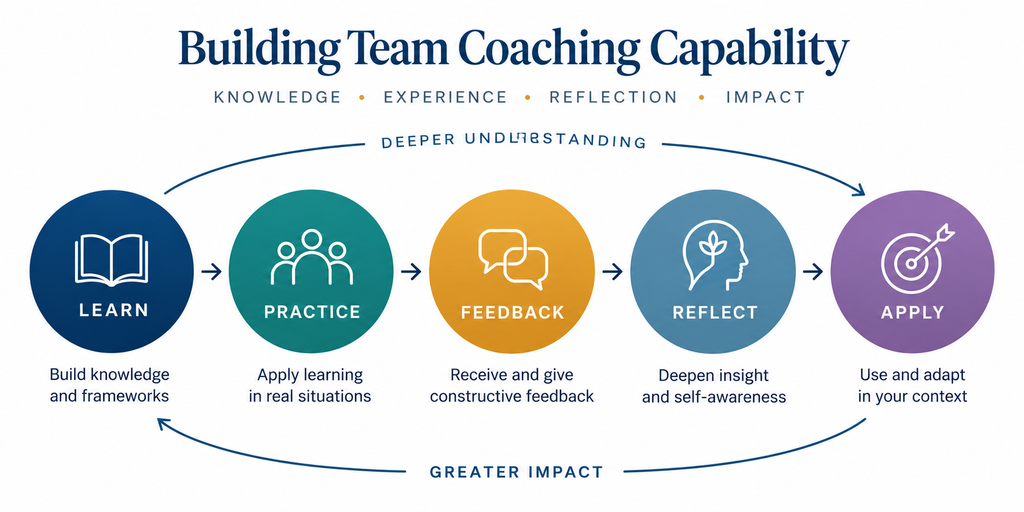
For this reason, team coaching education should combine knowledge with opportunities for practice, reflection and feedback.
Who Is Team Coaching Training For?
Team coaching training can be relevant to people entering the field from different professional backgrounds.
Some participants are already coaches who want to expand their practice from individual coaching into team coaching. Others may come from leadership, organizational development, learning and development, HR, consulting or related roles involving substantial work with teams.
You do not necessarily need to be a professional coach to begin developing team coaching capability. The entry requirements will depend on the particular program and the professional pathway you want to pursue.
This distinction becomes especially important if your longer-term goal is an ICF credential or certification. Participation in team coaching education and eligibility for an individual ICF credential are separate matters, with their own requirements.
How Is Team Coaching Training Different From Individual Coach Training?
Individual coach training primarily develops the capability to establish and work within a coaching relationship with an individual client.
Team coach training adds another layer of complexity.
The coach must learn to work with multiple relationships while continuing to hold the team as the collective client. What happens between team members becomes part of the coaching material.
A disagreement may reveal a recurring pattern. Silence may invite inquiry. A shift in participation may tell the team something about influence, trust or hierarchy. The coach needs to notice these possibilities without prematurely deciding what they mean.
Developing as a team coach therefore involves learning to move between individual voices, relationships, the team as a whole and the wider system.
Learn more about team coaching
What Should Team Coaching Training Include?
A strong team coaching training program should develop more than familiarity with models and tools.
Participants need opportunities to learn how to hold the team as the client, recognize team dynamics, work with multiple stakeholders, establish clear agreements, listen at several levels and support collective learning.
Training should also prepare participants to work with moments that are less predictable: disagreement, tension, changing participation, competing perspectives, power differences and patterns the team itself may not yet recognize.
Professional coaching competencies provide an important foundation. Team coaching education then needs to explore what applying those competencies looks like when the client is a team rather than one person.
Practice, observation, feedback and reflective learning are particularly important because knowing what a team coach should do is different from being able to do it while a team conversation is unfolding.
When evaluating team coaching training, consider whether you will have opportunities to:
- Practice coaching a team rather than only discuss team coaching
- Receive observation and feedback on your coaching
- Learn to hold the team as the collective client
- Work with conflict, power, hierarchy and changing participation
- Establish agreements across multiple stakeholders
- Reflect on your own influence within the coaching system
- Use coaching supervision to examine and develop your practice
- Understand how professional coaching competencies apply when the client is a team
What Skills Do You Develop Through Team Coach Training?
Effective team coach training develops the ability to notice and work with several levels of information simultaneously.
Participants may develop greater capability to listen to individual voices while hearing the collective conversation; recognize patterns of communication and participation; work with conflict and disagreement; notice power, hierarchy and influence; establish agreements across multiple stakeholders; support team reflection; and help teams take greater ownership of their learning.
Another important capability is knowing when not to interpret.
Team coaches frequently encounter incomplete information. A behavior may have several possible explanations, and the first interpretation that comes to mind may reflect the coach’s own assumptions as much as the team’s reality.
Learning to remain curious before reaching conclusions is therefore an important part of developing mature team coaching practice.
Why Does Intercultural Competence Matter in Team Coaching?
Teams rarely operate within a single cultural context.
National culture may be relevant, but so may gender, generation, profession, organizational culture, language, hierarchy, socioeconomic experience and other dimensions of identity and lived experience.
These influences can shape expectations around leadership, authority, participation, trust, disagreement, relationships and communication.
For a team coach, however, cultural knowledge should create possibilities for inquiry rather than conclusions about people.
A team member who rarely challenges a leader, for example, cannot automatically be explained through nationality, gender, generation or any other cultural category. Hierarchy, language, status, personality, organizational norms, previous experience or the particular situation may also be relevant.
This is why the Intercultural Coaching Academy integrates intercultural capability into team coaching development.
Culture generates questions, not answers about the client.
Cultural Intelligence (CQ), cultural self-awareness and disciplined inquiry can help team coaches become more aware of difference while remaining attentive to the uniqueness of the people and team in front of them.
Team coaching education should therefore help coaches notice when culture may be relevant, examine their own assumptions, explore multiple interpretations and inquire without turning cultural patterns into explanations about individual team members.
Why Are Practice and Feedback Important in Team Coaching Education?
Team coaching cannot be developed through theory alone.
In a live team coaching conversation, several things can happen simultaneously. One person may withdraw while another becomes more influential. A disagreement may emerge. The team leader may change the direction of the conversation. An important issue may remain unspoken.
The coach has to notice what is happening, decide whether an intervention is useful and consider how to intervene without taking ownership away from the team.
That capability develops through practice.
Meaningful team coaching education should therefore create opportunities to coach teams, observe team coaching, receive feedback and reflect on the choices made during the coaching process.
Feedback is particularly valuable when it helps coaches examine not only what they did, but what they noticed, what they assumed, what they chose to act on and what they may have missed.
The objective is not simply to know more about team coaching. It is to become more capable of practicing it.
Why Is Coaching Supervision Important for Team Coaches?
A team coach is not outside the system they are observing.
Coaches can become drawn into team dynamics. They may find themselves identifying with one member, responding differently to authority, avoiding a particular conflict or interpreting what they see through their own professional and cultural assumptions.
Coaching supervision provides a reflective space in which these experiences can be examined.
It can help the coach explore what may be happening within the team, within themselves and within the relationship between coach and team. It can also help the coach recognize patterns they may not have noticed while they were actively engaged in the work.
Because team coaching involves multiple relationships and greater systemic complexity, supervision has an important role in the continuing development of team coaching capability.
What Is ICF Team Coaching Education?
The International Coaching Federation (ICF) approaches team coaching as a specialized application of professional coaching. The ICF Team Coaching Competencies build on the ICF Core Competencies and identify additional considerations that arise when the client is a team.
These include working with multiple parties, maintaining focus on the team as a collective client, establishing appropriate agreements, attending to team dynamics and communication patterns, and supporting the team’s learning and autonomy.
When exploring ICF team coaching education, it is useful to distinguish between team coaching education, the accreditation of an education program, and an individual ICF credential or certification.
These are related, but they are not interchangeable. Completing team coaching education does not, by itself, mean that a participant has earned an ICF team coaching certification.
For coaches considering an ICF pathway, understanding these distinctions can help them evaluate whether a particular training program aligns with their professional goals.
Is Team Coaching Training the Same as Team Coaching Certification?
No. Training and certification are related, but they are not the same thing.
Team coaching training provides education and professional development. A certificate issued after completing a training program is also different from an individual certification awarded by a professional credentialing body.
The International Coaching Federation (ICF) offers the Advanced Certification in Team Coaching (ACTC) for individual coaches who meet its requirements. Completing team coaching education is one part of that pathway; ICF also has requirements relating to an existing ICF credential, team coaching experience, coaching supervision and assessment.
ICF also offers the Advanced Accreditation in Team Coaching (AATC) for qualifying team coaching education programs. AATC refers to the accreditation of an education program; ACTC refers to the certification of an individual coach.
For coaches considering an ICF pathway, it is important to review ICF’s current requirements directly.
Learn about ICF’s Advanced Certification in Team Coaching (ACTC)
How Long Does Team Coaching Training Take?
Team coaching training varies considerably in length and depth.
Shorter courses may introduce particular concepts, approaches or tools, while more substantial programs can provide greater opportunity to integrate theory with practice, observation, feedback, reflection and supervision.
The right level of education depends partly on what you want to do with it. Someone exploring team coaching as part of a broader professional role may have different goals from someone intending to build a substantial practice as a team coach or pursue an ICF team coaching pathway.
When comparing options, consider not only the number of training hours, but what those hours enable you to practice, experience and demonstrate.
The Intercultural Coaching Academy offers a 65-hour team coaching training program designed to develop the practical, relational and reflective capabilities needed to coach teams effectively.
How Do You Choose a Team Coaching Training Program?
When comparing a team coaching course or training program, look beyond the number of models and tools included.
Consider how much opportunity you will have to practice team coaching rather than simply learn about it. Look at how observation and feedback are incorporated, how the program approaches coaching supervision and reflective practice, and whether the learning is grounded in professional coaching competencies.
It can help to ask:
- How much actual team coaching will I practice?
- Will my coaching be observed, and will I receive feedback?
- How is coaching supervision incorporated?
- How does the program address conflict, power, hierarchy and culture?
- How does it prepare me to hold the team, rather than individual members, as the client?
- How does the education relate to ICF team coaching competencies and relevant professional pathways?
Faculty experience matters too. Team coaching is a complex relational practice, so it is worth understanding who will be teaching you and the professional experience they bring to the learning environment.
And ask perhaps the most useful question of all:
What will I be able to do differently after completing this training?
A strong program should help you develop capability, not simply accumulate knowledge.
Explore Our 65-Hour Team Coaching Program
The Intercultural Coaching Academy offers a 65-hour team coaching training program designed to develop the practical, relational and reflective capabilities needed to coach teams effectively.
The program brings together professional team coaching practice and intercultural capability, with particular attention to culture, identity, communication, hierarchy, relationships and the wider context in which teams operate.
Participants learn through a combination of theory, practice, observation, feedback, reflection and coaching supervision, with opportunities to apply their learning to the realities of working with teams.
The Academy was founded by two ICF Master Certified Coaches (MCCs), one of whom holds a PhD in Intercultural Communication. Both are members of SIETAR, bringing professional expertise and lived intercultural experience to the Academy’s approach.
Rather than preparing participants to become experts on other people’s cultures, we develop their capacity to notice more, question their interpretations and inquire more carefully while keeping the team at the center of the coaching process.