
Team coaching is a professional coaching approach that works with a team as a collective client. Rather than focusing primarily on the development of one individual, team coaching helps a team examine how its members work together, how relationships and patterns influence performance, and how the team can develop greater capacity to achieve its shared purpose and goals.
The International Coaching Federation (ICF) defines team coaching as a co-creative and reflective process that works with a team, its dynamics and relationships in support of its common purpose and shared goals. A critical distinction in the ICF approach is that the team itself is the client, even though that team is made up of multiple individuals.
This changes the nature of the coaching conversation.
A team coach listens not only to what individual members say, but also to what is happening between them: whose perspectives influence the conversation, which voices are heard, where conflict or alignment appears, how decisions are made, what remains unspoken, and which patterns help or hinder the team.

What Makes Team Coaching Different?
Putting several people in a room with a coach does not automatically make the work team coaching.
The defining shift is from primarily coaching individual members to coaching the team as an interconnected system.
A team may contain different personalities, roles, levels of authority, professional backgrounds, cultural identities and perspectives. Each person contributes to the team, but the team also develops collective patterns: ways of communicating, making decisions, responding to disagreement, sharing information, exercising influence and interpreting what is happening.
Team coaching brings these patterns into the team’s awareness so that members can reflect on them and decide what they want to strengthen, change or create together.
This is one reason team coaching requires capabilities beyond simply transferring one-to-one coaching techniques into a group setting. ICF identifies a broader knowledge base for team coaches that includes conflict, power dynamics, team cohesion, norms, participation, autonomy and sustainability.
The Team as the Client
One of the most important principles in professional team coaching is simple:
The team is the client.
That principle has significant practical consequences.
The coach may interact with a team leader, individual team members, sponsors and other stakeholders, but the coaching relationship continues to serve the team as a whole.
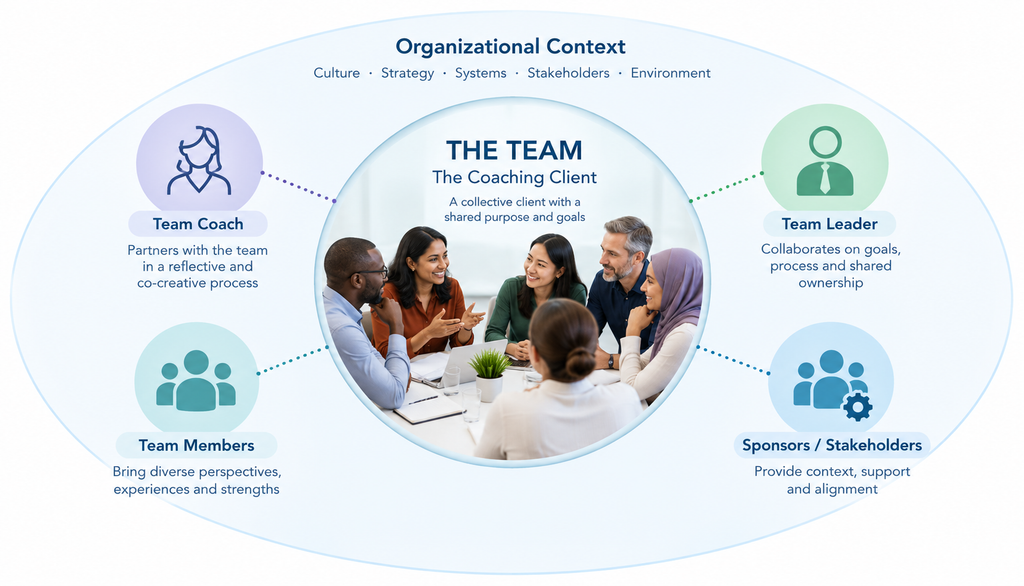
This requires the coach to remain attentive to alliances, subgroups and competing interests without becoming identified with one part of the team. It also makes agreements around confidentiality, individual conversations, sponsorship and stakeholder expectations particularly important.
ICF explicitly describes the client in team coaching as the team as a single entity and emphasizes the coach’s objectivity in relationships with individual members, sponsors and stakeholders.
The central question therefore shifts from:
“How can I help this person?”
to:
“What is happening in this team, and what does the team need to become more aware of?”
What Does a Team Coach Pay Attention To?
A team coach works with several levels of information at the same time.
At the individual level, the coach notices what different members are experiencing, contributing and communicating.
At the relational level, the coach attends to what happens between members, including trust, tension, influence, alliances and patterns of interaction.
At the collective level, the coach notices how the team understands its purpose, identity, goals, norms and ways of working.
At the systemic level, the coach remains aware of the organizational environment, stakeholders, hierarchy, culture and wider conditions influencing the team.
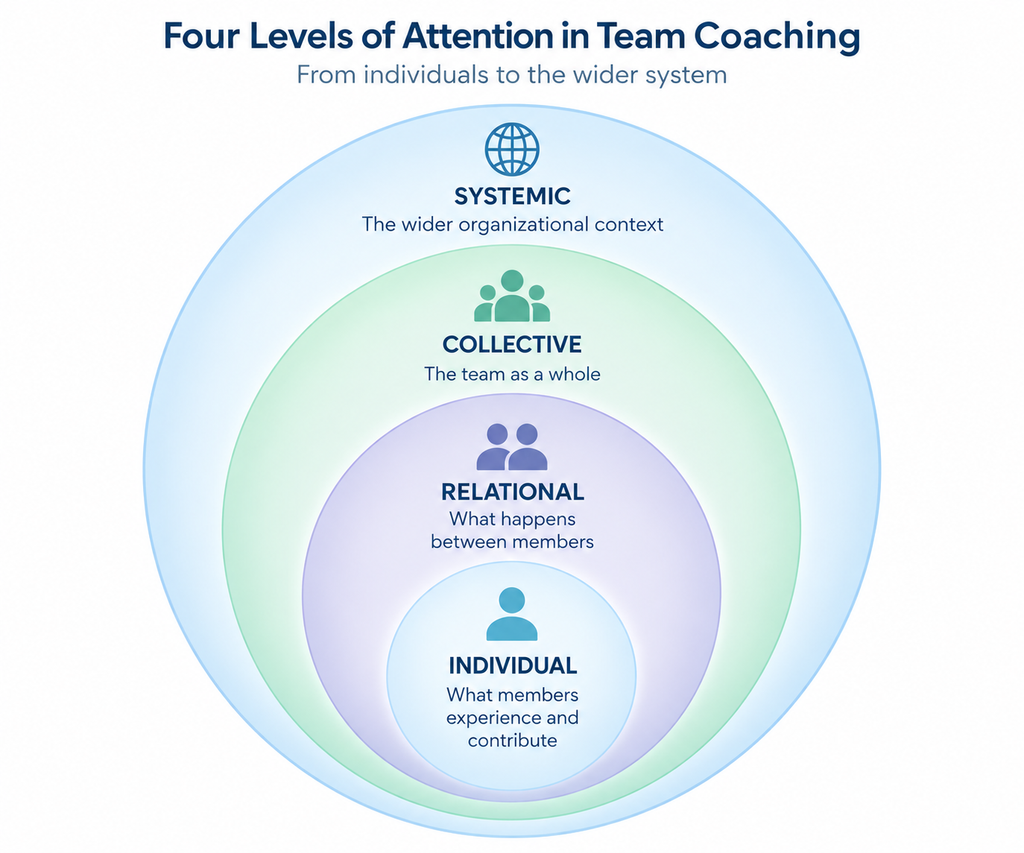
ICF’s Team Coaching Competencies reflect this complexity. They call attention to how individual perspectives relate to the wider team dialogue, how members affect collective energy and engagement, and how verbal and non-verbal patterns may reveal alliances, conflicts and opportunities for growth.
Effective team coaching therefore requires the capacity to move between the parts and the whole without losing sight of either.
When Is Team Coaching Used?
Organizations may use team coaching when a team wants to improve how it works together, not simply increase the capability of individual members.
This can include teams navigating leadership transitions, changes in membership, growth, conflict, strategic change, new responsibilities or increasing complexity.
It can also support established teams that are functioning well but want to become more effective, more reflective or better able to sustain their performance.
The purpose is not necessarily to “fix” a dysfunctional team.
Team coaching can help teams develop greater awareness of how they operate, strengthen communication and collaboration, examine assumptions, work with conflict, clarify shared goals and increase their capacity to learn together.
Ultimately, the team should become increasingly capable of doing this work for itself. ICF describes sustainability as an important purpose of team coaching and emphasizes gradually transferring ownership of the coaching process to the team leader and team collectively.
Team Coaching and Individual Coaching
Individual and team coaching share the foundations of professional coaching, including partnership, inquiry, reflection, awareness, learning and client agency.
The difference lies primarily in who the client is and what the coach must attend to.
In individual coaching, the coach works primarily with one person’s goals, meaning-making and development.
In team coaching, the coach works with a collective client made up of multiple individuals whose relationships and interactions are themselves part of the coaching material.
A comment from one person may affect five others.
A silence may mean different things to different members.
A disagreement may concern the topic being discussed, or it may reveal something about hierarchy, trust, identity or established patterns of influence.
The team coach therefore listens simultaneously to individuals, relationships and the collective system.
Team Coaching, Facilitation, Training and Consulting
Team coaching exists alongside other forms of team development, including team building, training, consulting, mentoring and facilitation. These approaches can all be valuable, but they do not serve the same purpose.
Training typically introduces knowledge or develops particular skills.
Consulting brings expertise, analysis or recommendations.
Facilitation helps a group structure dialogue, participation or decision-making.
Team coaching helps the team examine its own dynamics, relationships, assumptions and patterns and develop greater capacity to move forward together.
The boundaries are not always absolute. ICF’s research notes a particularly close relationship between team coaching and facilitation, while describing training, consulting and mentoring as more directive modalities. It therefore emphasizes clarity when coaches move between different team-development roles.
That clarity matters professionally and ethically.
What Happens in a Team Coaching Engagement?
A team coaching engagement usually begins before the first full-team coaching conversation.
The coach needs to understand who the client is, why coaching is being considered, who the relevant stakeholders are, what outcomes are sought and how confidentiality and information sharing will work.
Contracting can therefore be considerably more complex than in individual coaching.
ICF’s Team Coaching Competencies specifically address agreements involving team leaders, team members, stakeholders and co-coaches. They also emphasize confidentiality and consideration of the organization’s culture, mission and wider context.
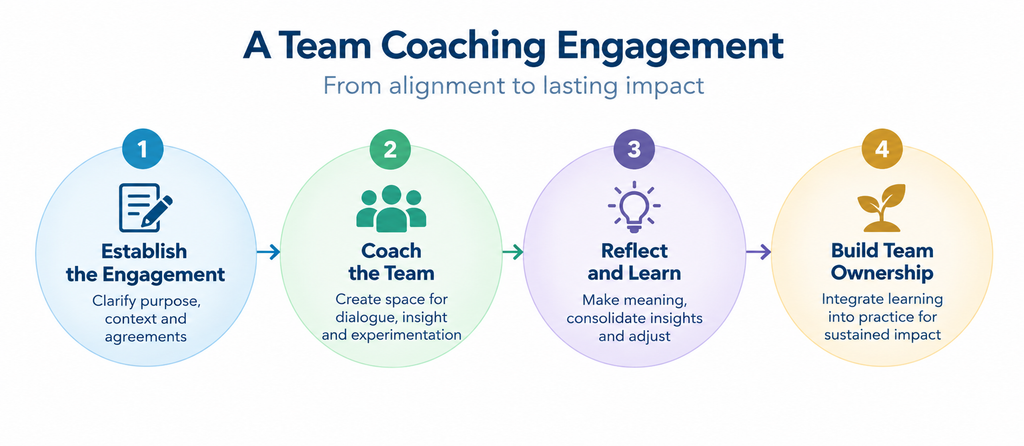
Once the work begins, the coach may help the team notice and explore what is occurring in real time.
Rather than only discussing how the team works, the team can learn from how it is working in the coaching conversation itself.
Who speaks?
Who waits?
Whose ideas gain traction?
What happens when someone disagrees?
How does hierarchy influence participation?
What happens when tension enters the room?
What does the team avoid?
These moments can become valuable material for reflection because patterns appearing in the coaching session may also appear elsewhere in the team’s work.
Team Dynamics, Culture and Context
Every team develops within a context, and every team is culturally complex.
Culture may include nationality, but it is not limited to nationality. Team members may also bring different generational, gender, professional, organizational, linguistic and other lived cultural experiences.
These differences can influence expectations around leadership, authority, disagreement, trust, participation, time, relationships and communication.
But cultural knowledge must be used carefully.
A team coach should not see a pattern and immediately decide that culture explains it.
At the Intercultural Coaching Academy, we work from a simple principle:
Culture generates questions, not answers about the client.
The same principle applies to teams.
A quiet team member may be responding to hierarchy, language, personality, uncertainty, professional status, cultural expectations, the topic under discussion or something else entirely.
The coach’s task is not to decide what the silence means because of what they know about a cultural group. It is to notice the possibility of cultural influence and create conditions in which the team can explore meaning for itself.
This is where intercultural competence becomes particularly important in team coaching. The coach is working not with one cultural perspective but with multiple identities, interpretations and relationships operating simultaneously.
ICF’s current ethical guidance also calls coaches to remain alert to cultural filters and to relationships shaped by bias, power dynamics and systemic oppression.
Team Coaching and Professional Coaching Competencies
Team coaching remains grounded in professional coaching competence.
The ICF Team Coaching Competencies describe additional knowledge and skills required when professional coaches work with teams, while the ICF Core Competencies remain the foundation for coaching practice.
In a team context, this includes maintaining awareness of team dynamics, establishing agreements with multiple stakeholders, creating conditions for open interaction, encouraging participation, working with team rules and norms, noticing collective communication patterns, addressing conflict, challenging team assumptions and supporting the team’s ownership of its learning.
Professional team coaching therefore requires more than knowledge about teams.
It requires the ability to coach the team while its dynamics are unfolding.
Developing Team Coaching Capability
An experienced individual coach does not automatically become an effective team coach simply by beginning to work with several people at once.
Team coaching introduces additional complexity.
The coach must hold the team as the client while remaining attentive to individuals. They must work with multiple relationships and stakeholders, notice emerging patterns, understand power and conflict, establish more complex agreements and remain clear about when they are coaching and when another team-development modality is being used.
They must also be capable of remaining present when several things are happening at once.
ICF highlights coaching supervision as particularly important in team coaching because of the complexity of team dynamics and the ease with which a coach can become caught in those dynamics.
Developing team coaching capability therefore involves more than learning techniques. It requires education, practice, reflection, feedback and the development of the coach’s capacity to perceive and work with the team as a collective system.
Developing Your Practice as a Team Coach
Professional coaches who want to expand into team coaching need opportunities to develop these capabilities deliberately.
Structured team coaching training can help coaches deepen their understanding of team dynamics, practice team coaching skills, work with professional team coaching competencies, receive feedback and learn to navigate the ethical and relational complexity of coaching a collective client.
For coaches working across cultures, this development also needs to include the ability to recognize how culture, identity, context, hierarchy and difference may influence the team without reducing individual members to cultural categories.
If you are exploring education in this area, learn more about team coaching training and what to consider when choosing a professional team coaching program.
Explore Team Coaching Training
If you are ready to explore a comprehensive educational pathway: