
Intercultural coaching is a professional coaching approach that recognizes culture as an important part of how people understand themselves, relate to others, make decisions, communicate, lead, and respond to change. It brings cultural awareness into the coaching process while keeping the individual, rather than a cultural category, at the center of the conversation.
Intercultural coaching is often associated with people who work across countries and cultures. A leader may be taking on an international role, managing a multicultural team, relocating to another country, or working with colleagues whose expectations and communication styles differ from their own. These are familiar examples, but intercultural coaching is relevant in many other situations too.
Culture is not limited to nationality. Our perspectives can also be shaped by gender, generation, ethnicity, language, profession, organization, family, education, socioeconomic background, and lived experience. These influences overlap, and their significance varies from one person and situation to another.
This means that cultural differences can matter even when a coach and client come from the same country. They may have very different understandings of authority, trust, responsibility, conflict, relationships, success, leadership, or what it means to speak openly.
For the coach, the challenge is to remain curious about these influences without assuming that culture explains the client.
At the Intercultural Coaching Academy, one principle captures this approach:
Culture generates questions, not answers about the client.
Cultural knowledge can help a coach notice possibilities that might otherwise be missed. It should not be used to predict what an individual thinks, values, or needs.
There is another important part of this work. The client is not the only person in the coaching relationship who has a cultural perspective. The coach brings one too.
Intercultural coaching therefore pays attention to culture in the client, the coach, the relationship between them, and the wider context in which the coaching takes place.
The purpose is not to become an expert in every culture. It is to develop the awareness, cultural intelligence, curiosity, humility, and adaptability needed to work thoughtfully with cultural complexity.

What Makes Intercultural Coaching Different?
Professional coaching already asks coaches to listen carefully, remain curious, avoid imposing their own solutions, and understand the client within their context. Intercultural coaching builds on these foundations by making cultural influences more visible when they are relevant to the coaching conversation.
Imagine a client who says that they struggle to challenge their manager.
The coach might explore confidence, fear, previous experiences, beliefs about conflict, or the relationship with the manager. An intercultural perspective opens additional possibilities. What does challenging someone in authority mean to this client? How were disagreement and respect understood in the environments in which they learned to live and work? Do age, gender, professional status, organizational norms, or expectations about hierarchy affect what feels possible?
These questions matter because familiar coaching concepts do not always carry the same meaning across contexts.
Speaking up may be interpreted as confidence in one setting and poor judgment in another. Direct disagreement can signal honesty and engagement, or it can damage trust. A leader who waits before expressing an opinion may be seen as hesitant by one person and thoughtful by another.
Intercultural coaching encourages the coach to explore these meanings rather than assume them.
A useful question becomes:
“What might this mean in this person’s context?”
When Is Intercultural Coaching Used?
Intercultural coaching can be valuable whenever cultural differences, identities, expectations, or ways of making meaning affect a person’s work, relationships, leadership, or experience of change.
It is commonly used with leaders working internationally, people moving into new cultural environments, multicultural and global teams, expatriates and repatriates, and professionals whose roles require them to build relationships across cultural boundaries.
Its relevance is broader than international work.
A senior leader may be struggling to understand younger employees whose expectations about feedback, loyalty, flexibility, and career development differ from their own. A woman moving into an executive role may be navigating expectations related to gender, authority, and the culture of her organization. Colleagues from the same country may have very different approaches to hierarchy because of their professional backgrounds, generations, family histories, or organizational experiences.
Intercultural coaching can also be relevant during organizational change, mergers, international assignments, leadership transitions, conflict, team development, and conversations about identity and belonging.
Sometimes culture is the obvious reason a client seeks coaching. At other times, its relevance becomes apparent only as the conversation develops.
What Does Culture Mean in Intercultural Coaching?
In everyday conversation, culture is often used as another word for nationality. National culture can influence how people communicate, relate to authority, build trust, make decisions, or approach relationships, but it is only one part of a person’s cultural experience.
People participate in many cultural groups and systems at the same time.
Professional cultures influence how people learn to think and behave within their fields. Organizations develop their own expectations, language, rituals, and unwritten rules. Generations are shaped by different historical and technological environments. Gender can influence expectations surrounding authority, voice, emotion, caregiving, ambition, and leadership.
Language, religion, ethnicity, geography, education, socioeconomic background, family, community, and migration experience may also be significant.
At the Intercultural Coaching Academy, we pay particular attention to three dimensions: national, gender, and generational culture. We use them as contexts for inquiry rather than categories for defining people.
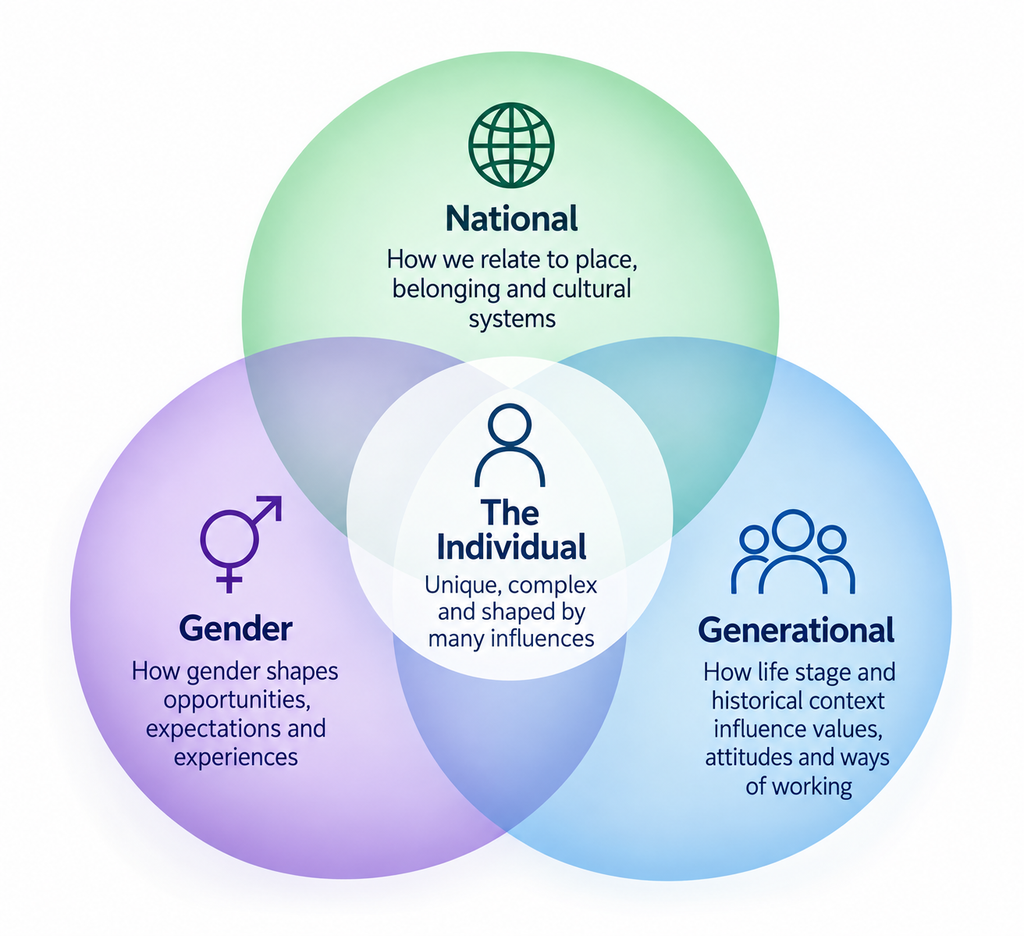
Their significance changes with context. Nationality may become especially visible when someone relocates. Gender may become more significant when a leader enters a senior team in which they are underrepresented. Generational identity may come to the foreground during a disagreement about expectations of work.
The question is therefore not simply which cultures a person belongs to, but which aspects of culture are relevant to what is happening now.
How Culture Can Shape the Coaching Conversation
Culture influences more than the subjects people bring to coaching. It can also affect how the conversation itself unfolds.
Consider silence.
A coach may experience a long silence as discomfort and feel an urge to ask another question. The client may be using that same silence to think carefully. In another context, silence might communicate respect, uncertainty, disagreement, emotional restraint, or concern about saying something that could affect a relationship.
Similar differences can appear around eye contact, emotional expression, directness, storytelling, decision making, challenge, self disclosure, pace, and the amount of structure a client expects.
Cultural expectations can also influence the coaching relationship itself. Some clients may expect a professional to provide answers. Others may expect a highly collaborative exchange. Some may challenge a coach readily, while others may hesitate to disagree even when something the coach has said does not fit.
Intercultural coaching requires sensitivity to these dynamics as they emerge, rather than relying only on knowledge about cultural groups.
The Coach Has a Culture Too
Coaches are also culturally situated.
We have learned ways of communicating, relating, working, disagreeing, showing emotion, using time, understanding responsibility, and defining success. Professional coach education adds another layer, with its own language, values, practices, and assumptions about what a productive coaching conversation looks like.
Much of this can feel normal rather than cultural precisely because it is familiar to us.
This becomes important when a client’s behavior feels surprising, frustrating, passive, inappropriate, confusing, or ineffective. Before treating that reaction as information about the client, the coach can examine the interpretation itself.
Why does this seem unusual to me?
What expectation am I bringing?
Would another interpretation be possible?
What does the client say this means?
This reflective capacity helps coaches distinguish what they are observing from the meaning they may be assigning to it.
Cultural Intelligence and Intercultural Coaching
Cultural intelligence, often referred to as CQ, concerns our capacity to function effectively in culturally diverse situations. For coaches, it provides an important foundation for working across difference.
Cultural knowledge can broaden the possibilities a coach notices. Awareness can help identify assumptions and alternative interpretations. Motivation supports engagement when difference creates uncertainty. Adaptability allows communication and behavior to change when the situation calls for it.
In coaching, these capabilities must be applied within the responsibilities of the coaching relationship.
Knowing that approaches to hierarchy vary across cultures is useful. Exploring what authority means for this particular client requires coaching skill. Recognizing differences in communication styles is useful. Knowing when and how to adapt while preserving the client’s agency requires something more.
This is where cultural intelligence becomes particularly relevant to intercultural coaching practice.
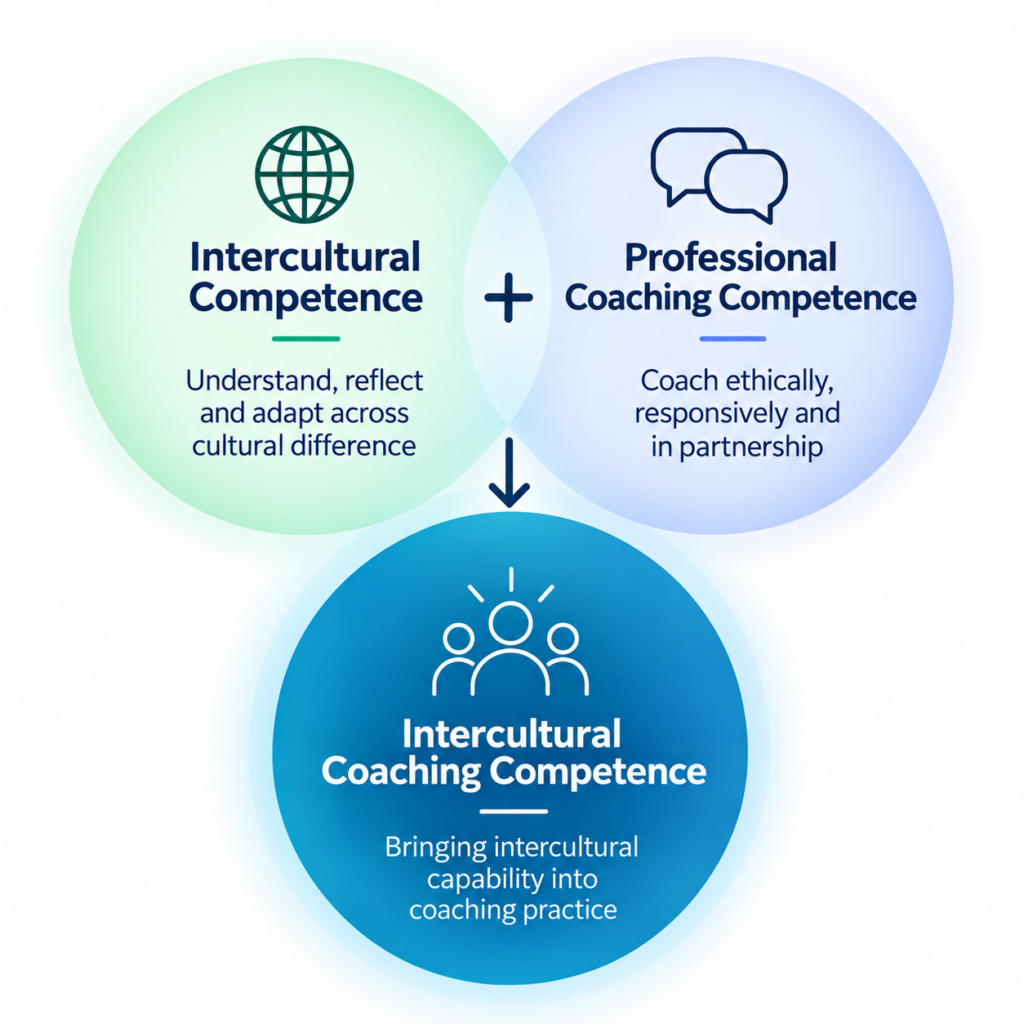
From Intercultural Competence to Intercultural Coaching Competence
Intercultural competence refers broadly to the knowledge, attitudes, awareness, and skills that support effective and appropriate engagement across cultural differences.
Intercultural coaching competence brings those capabilities into professional coaching practice.
It includes recognizing when culture may be relevant, exploring cultural meaning with the client, reflecting on one’s own cultural position, adapting appropriately, attending to power and context, and maintaining the client’s agency throughout the process.
This distinction matters. Understanding culture and being able to coach effectively when culture becomes relevant are related, but they are not the same capability.
At the Intercultural Coaching Academy, the LENSES Framework supports the development and application of intercultural coaching competence. The framework is explored separately on our Understanding the LENSES Framework page.
Working With Cultural Knowledge Without Stereotyping
Cultural models can help coaches recognize patterns and possibilities that might otherwise remain invisible. Their usefulness depends on how they are applied.
A pattern identified at group level does not predict the beliefs or behavior of an individual.
For example, research or a cultural model might suggest that hierarchy tends to be approached differently in two cultural contexts. That information may give the coach something useful to consider. It does not tell the coach how this particular client experiences authority.
Cultural knowledge works best as a source of hypotheses.
The coach can introduce possibilities, remain attentive to patterns, and allow the client’s experience to confirm, reject, or complicate what the coach thinks they know.
This requires cultural humility, particularly when working with cultural contexts that are unfamiliar to the coach. No coach can know every culture they will encounter. Recognizing the limits of one’s knowledge is part of competent practice.
Our Language, Models and Tools resource explores cultural frameworks and their use in greater depth.
Intercultural Coaching in Practice
Consider a leader who has recently taken responsibility for a team in another country. She is frustrated that team members rarely challenge her ideas during meetings. She interprets the lack of debate as low engagement and begins encouraging people to speak up.
An intercultural coaching conversation might broaden the picture.
What does disagreement with a senior leader mean in this team? Is disagreement expressed differently? Does language confidence affect participation? Do team members perceive any risk in challenging authority? Could the leader’s role, age, gender, or communication style influence the dynamic?
The goal is to help the leader investigate rather than guess.
Now consider a senior executive who describes younger employees as lacking commitment because they question long working hours and want greater flexibility.
Coaching could explore what the executive means by commitment, how that definition developed, whether expectations about work have changed across generations, and what the organization itself rewards.
Or consider a woman who has repeatedly been told that she needs to become more assertive to progress into senior leadership.
The coaching conversation might explore what assertiveness means in that organization, which leadership behaviors are rewarded, whether those behaviors are interpreted differently depending on who demonstrates them, and how gender, national, and organizational expectations interact.
In each case, cultural awareness expands what can be explored without predetermining the answer.
Intercultural Coaching and Professional Coaching Competencies
Intercultural coaching remains grounded in professional coaching practice.
Capabilities such as listening, curiosity, self awareness, adapting communication, establishing trust, supporting client autonomy, and attending to context become particularly important when coach and client may hold different assumptions about relationships, authority, communication, identity, or change.
For coaches working within the ICF framework, intercultural awareness can support the application of the ICF Core Competencies. It is not an additional ICF competency, and an intercultural framework does not replace ICF standards.
Its contribution lies in helping coaches consider how established coaching competencies are practiced when cultural complexity is present.
Intercultural Coaching and Cross Cultural Coaching
The terms intercultural coaching and cross cultural coaching are sometimes used interchangeably.
Cross cultural work has traditionally placed greater emphasis on comparing cultural groups, particularly national cultures. Such comparisons can help people recognize differences in expectations and practices.
Intercultural coaching places greater emphasis on the interaction between cultural perspectives and on what happens when different ways of understanding, communicating, and relating meet.
In practice, terminology varies across researchers and practitioners. More important than the label is the quality of the approach and the way cultural knowledge is used within coaching.
Intercultural Coaching, Training and Consulting
Intercultural training, consulting, and coaching can all support people working across cultures, but they serve different purposes.
Training typically introduces knowledge, concepts, frameworks, and skills. Consulting may provide specialist analysis and recommendations.
Coaching works with the client’s goals, experience, thinking, and choices. The coach may draw on intercultural knowledge to inform their awareness and questions, but the client remains responsible for determining what is meaningful and how they want to move forward.
These approaches can complement one another. A leader may need cultural knowledge as well as space to examine how that knowledge applies to a particular relationship or challenge.
Developing Intercultural Coaching Capability
Developing intercultural coaching capability is an ongoing process.
It involves building knowledge about culture, increasing awareness of one’s own cultural positioning, encountering different perspectives, becoming more comfortable with uncertainty, and learning how to adapt appropriately while remaining grounded in professional coaching practice.
The goal is not cultural mastery.
It is the capacity to enter culturally complex situations with knowledge and curiosity, notice more of what may be happening, question one’s interpretations, adapt when appropriate, and continue to treat the client as the primary source of meaning about their own experience.
That is the capability at the heart of intercultural coaching.