
An intercultural coach is a professional coach who can recognize and work thoughtfully with culture when it becomes relevant to the client, the coaching relationship, or the wider context.
This does not mean knowing everything about every culture. Nor does it mean explaining a client through nationality, gender, generation, or any other cultural category.
An intercultural coach develops the awareness and capability to notice when culture may matter, explore its meaning with the client, reflect on their own assumptions, and adapt their coaching without losing sight of the individual.
At the Intercultural Coaching Academy, this is captured in one guiding principle:
Culture generates questions, not answers about the client.
The distinction is important. Cultural knowledge can help a coach notice possibilities. Intercultural coaching competence helps the coach know what to do with those possibilities in a coaching conversation.

What Makes a Coach an Intercultural Coach?
Working with international clients does not automatically make someone an intercultural coach.
Neither does living abroad, speaking several languages, studying cultural models, or having extensive experience with people from different countries. All of these experiences can contribute to intercultural capability, but the practice asks something more of the coach.
An intercultural coach learns to work with cultural complexity without reducing the client to culture.
That means being able to recognize that several explanations may be possible when something happens in coaching. A client’s reluctance to challenge a senior leader, for example, might involve confidence, personality, previous experience, organizational politics, professional status, age, gender, expectations about hierarchy, or several of these at once.
The intercultural coach does not need to decide which explanation is correct.
The coach needs the awareness to notice the possibilities and the coaching skill to explore them with the client.
This is one reason we distinguish intercultural competence from intercultural coaching competence. Understanding cultural difference is valuable. Being able to coach effectively when cultural difference becomes relevant is a further professional capability.
What Does an Intercultural Coach Pay Attention To?
An intercultural coach develops a wider field of attention.
There is, first, the client. What does this experience mean to this person? Which aspects of identity, culture, history, relationships, and context matter to them?
There is also the coach. What expectations, preferences, assumptions, and interpretations is the coach bringing into the conversation?
Then there is the coaching relationship. How are trust, communication, challenge, silence, emotion, authority, or disagreement being experienced between coach and client?
And finally, there is the wider context. What organizational norms, professional cultures, social expectations, power relationships, or cultural systems may be influencing what is happening?
The ability to move among these perspectives helps the coach avoid an overly simple cultural explanation.
Sometimes culture will be central to the client’s experience. Sometimes it will be one influence among many. Sometimes an assumption that initially appears cultural will turn out to have another explanation.
The client remains the most important source of meaning.
What Capabilities Does an Intercultural Coach Develop?
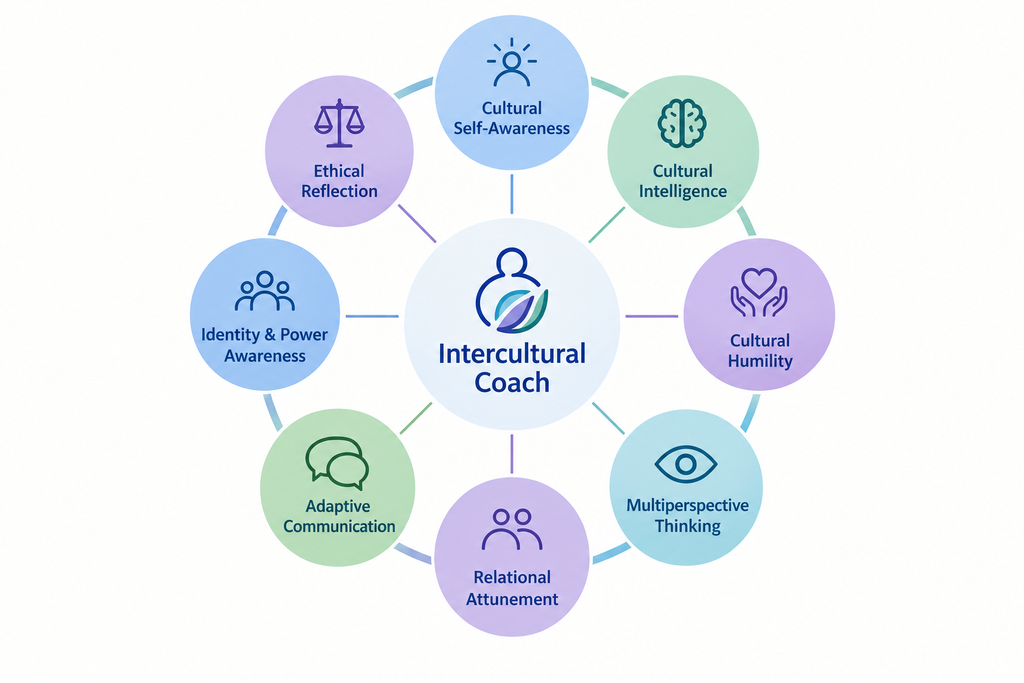
Intercultural coaching requires professional coaching competence, but it also asks the coach to develop particular capacities for working when culture, identity, and difference enter the conversation.
Cultural self-awareness is the ability to recognize one’s own cultural positioning. Coaches have learned ways of communicating, building relationships, handling disagreement, using time, expressing emotion, understanding authority, and defining effective behavior. These preferences can easily feel universal when they are familiar.
Cultural intelligence helps the coach engage effectively when perspectives, expectations, and ways of behaving differ. It supports curiosity, knowledge, awareness, and the capacity to adapt appropriately.
Cultural humility allows the coach to remain knowledgeable without assuming expertise over another person’s experience. It includes recognizing the limits of what we know and being willing to learn from the client.
Multiperspective thinking helps the coach resist settling too quickly on one explanation. The coach becomes able to consider individual, cultural, relational, organizational, and systemic possibilities before deciding what may be relevant.
Relational attunement involves paying attention to how meaning is being created in the conversation, including through language, silence, emotion, pace, context, and what may remain unspoken.
Adaptive communication allows the coach to adjust how they communicate, structure the conversation, challenge, or create space when adaptation would better serve the client.
Awareness of identity and power helps the coach notice how status, hierarchy, belonging, gender, generation, professional role, organizational norms, and other dimensions of identity can influence participation and choice.
Ethical reflection helps the coach consider the impact of their interventions, recognize when an assumption or interaction has created difficulty, and respond responsibly when repair is needed.
These capabilities are interconnected. They develop through education, experience, practice, reflection, feedback, and continued exposure to perspectives beyond one’s own.
Cultural Knowledge Is Important, but It Is Not Enough
Intercultural coaches benefit from understanding cultural theories, research, communication patterns, cultural intelligence, and different approaches to identity and cultural difference.
This knowledge can make previously invisible possibilities easier to notice.
But cultural knowledge has limits.
A model may describe patterns found within a group or population. It cannot tell a coach what an individual client believes, values, wants, or will do.
The intercultural coach therefore learns to use knowledge as a resource for inquiry rather than a source of conclusions.
This is particularly important when a coach encounters a culture they know little about. Competence does not require pretending to know. It requires knowing how to remain curious and professionally effective when knowledge is incomplete.
Our Language, Models and Tools resource explores this aspect of intercultural coaching in greater depth.
How Does an Intercultural Coach Avoid Stereotyping?
Stereotyping becomes a risk when information about a group is used to explain an individual without sufficient inquiry.
An intercultural coach takes a different approach.
If cultural knowledge suggests that hierarchy may be understood differently in a particular context, the coach does not conclude that the client has a particular attitude toward authority.
Instead, that knowledge may prompt a better question.
What does authority mean to this client?
How comfortable do they feel disagreeing with someone senior?
What have they learned about respect?
Does age or professional status affect the relationship?
What happens in their organization when someone challenges a leader?
The difference is subtle but fundamental.
Cultural knowledge expands what the coach is able to notice. The client determines what is meaningful.
That is why cultural humility is not the absence of cultural knowledge. It is a way of holding knowledge responsibly.
The Intercultural Coach Is Part of the Cultural Encounter
Intercultural coaching is sometimes imagined as a coach learning how to understand culturally different clients.
That is only half of the picture.
The coach also enters the relationship with cultural experiences, identities, preferences, professional training, and assumptions.
A coach may prefer direct communication. Another may value emotional expression. One may regard punctuality as a sign of respect. Another may believe that openly challenging an idea demonstrates engagement.
Even our ideas about what a “good coaching client” should do can carry assumptions.
Intercultural development therefore involves becoming increasingly aware of the lens through which we interpret what happens in coaching.
The question is not simply:
“What is happening with this client?”
It is also:
“How might my own perspective be influencing what I think is happening?”
That shift from observing difference to examining the relationship is central to intercultural coaching competence.
Intercultural Coaching and Professional Coaching Competence
Intercultural capability does not replace professional coaching competence.
An intercultural coach still needs to establish agreements, build trust, listen deeply, remain present, evoke awareness, support learning and growth, and work ethically within the responsibilities of the coaching relationship.
What intercultural competence adds is greater sensitivity to how those capabilities may need to be practiced when coach and client do not share the same assumptions about communication, authority, relationships, identity, learning, or change.
For coaches working within the ICF framework, this is an important distinction. ICF’s current Core Competencies establish the framework for professional coaching practice and include respect for clients’ identities, openness, curiosity, adaptability, trust, partnership, active listening and client autonomy.
Intercultural coach is not an ICF credential, and intercultural coaching competence is not an additional ICF Core Competency.
Rather, intercultural development can deepen a coach’s capacity to apply established professional coaching competencies when cultural complexity is present.
Who Might Work With an Intercultural Coach?
People do not need to be relocating internationally to benefit from an intercultural perspective.
An executive may be leading colleagues across several countries. A manager may be struggling to understand generational differences within a team. A professional may be navigating expectations associated with gender and leadership. Someone entering a new organization may be trying to understand its unwritten rules. A leader may be working in their second or third language. A client may be questioning where they belong after years of living across different cultural environments.
Intercultural coaches may also work with expatriates and repatriates, global leaders, multicultural teams, internationally mobile professionals, people navigating cultural transitions, and leaders responsible for increasingly diverse organizations. These remain common areas of contemporary intercultural coaching practice.
What these situations share is not necessarily nationality.
They involve encounters between different ways of understanding, communicating, relating, leading, belonging, or making meaning.
How Do You Become an Intercultural Coach?
There is no point at which a coach can reasonably say, “I now know culture.”
Developing as an intercultural coach is an ongoing process.
It begins with a sound foundation in professional coaching. Intercultural knowledge cannot compensate for weak coaching practice.
From there, coaches can deepen their understanding of culture and intercultural communication, develop cultural intelligence, examine their own cultural identities and assumptions, learn to recognize multiple perspectives, and become more comfortable working when they do not immediately understand what is happening.
Practice matters as much as knowledge.
Coaches need opportunities to work with culturally complex cases, receive feedback, reflect on their responses, notice where assumptions arise, experiment with adaptation, and learn from moments when their interpretation was incomplete or wrong.
Exposure to cultural difference is valuable, but experience alone is not enough. Someone can work internationally for many years without necessarily examining the assumptions through which they interpret other people.
The developmental task is therefore both outward and inward.
Learn more about culture. Learn more about yourself. Then learn how both enter the coaching relationship.
Developing Intercultural Coaching Competence
At the Intercultural Coaching Academy, we describe the developmental goal as intercultural coaching competence.
Our approach brings together professional coaching competence with intercultural awareness, cultural intelligence, cultural humility, contextual judgment, and reflective practice.
The Academy’s LENSES Framework provides a structure for developing this capability through six interconnected lenses: Locate, Explore, Notice, Shift, Examine, and Steward.
The framework helps coaches consider their own positioning, explore multiple explanations, listen for meaning, adapt appropriately, attend to power and inclusion, and reflect ethically on impact.
The detailed framework is explored separately in Understanding the LENSES Framework. That keeps the focus here where it belongs: on the development of the intercultural coach.
How Do You Choose an Intercultural Coach?
Because intercultural coach is used in different ways across the profession, it is worth looking beyond the title.
Ask about the coach’s professional coaching education and experience. Explore what intercultural education or development they have undertaken. Ask how they work with cultural knowledge and what they do when they know little about a client’s cultural context.
Listen carefully to how the coach talks about culture.
A thoughtful intercultural coach should be able to discuss cultural patterns without presenting people as predictable representatives of a country or group. They should be comfortable acknowledging the limits of their knowledge. They should also be able to explain how they reflect on their own assumptions and adapt their practice while maintaining professional and ethical boundaries.
Credentials, intercultural education, lived experience, languages, international work, and specialist knowledge can all be relevant. None should substitute for the quality of the coaching relationship and the coach’s capacity to treat the client as an individual.
A useful question to ask a prospective coach is:
“How does culture influence the way you coach?”
The answer can tell you considerably more than the title intercultural coach alone.
The Intercultural Coach as a Reflective Practitioner
The strongest intercultural coaches are not those who have accumulated the greatest number of cultural answers.
They are coaches who have developed the capacity to notice more, question their interpretations, remain present with uncertainty, adapt thoughtfully, and continue learning from the people they coach.
They understand that culture matters, but that it never tells the whole story.
They know that the client’s cultural perspective deserves attention, and that their own perspective deserves examination.
And they understand that professional coaching across cultural complexity requires both knowledge and humility.
An intercultural coach does not need to know everything about everyone.
They need to know how to coach when difference matters.