
Cultural Models and Tools for Intercultural Coaching
Intercultural coaching requires more than cultural knowledge. It requires the ability to distinguish between what we know, observe, interpret and assume.
This resource introduces some of the terminology, cultural models and practical tools used throughout our program. The aim is not to teach coaches to categorize people by culture, but to use cultural knowledge thoughtfully while keeping the individual, relationship and context at the center.
Culture generates questions, not answers about the client.
1. Getting the Language Right
Language shapes how we understand cultural difference. Throughout the program, we make several important distinctions.
Intercultural
Intercultural refers to the interaction and relationship between people with different cultural backgrounds and experiences.
This is our primary orientation because coaching happens between people. We are interested not only in cultural differences, but in what happens when different perspectives, identities and meaning systems meet.
Cross-cultural
Cross-cultural generally refers to comparing cultures or cultural groups.
Cross-cultural research and models can be valuable sources of knowledge. However, they describe patterns at a group level and should not automatically be applied to an individual client.
Intercultural Competence
The capacity to work effectively across cultural difference through awareness, knowledge and skills.
Coaching Competence
The capacity to facilitate client growth through professional coaching competencies.
Intercultural Coaching Competence
The integration of the two: professional coaching competence applied with cultural awareness, attunement and contextual judgment.
This is what the LENSES Method is designed to develop.
2. What Do We Mean by Culture?
In our program, culture is understood as the shared systems of meaning—values, norms, practices and histories—that influence how people make sense of behavior and experience.
Culture can include much more than nationality. It may involve:
National · Organizational · Professional · Gender · Generational · Lived Experience
The important distinction is that culture provides context for inquiry, not a prediction about the person.
For example, imagine a client remains silent during a team discussion.
Silence might reflect:
- an individual preference or personality;
- a cultural expectation about when and how to speak;
- a relational issue, such as not feeling safe;
- or a systemic issue, such as hierarchy or a meeting structure that limits participation.
The intercultural coach does not rush to decide which explanation is correct.
The coach holds the possibilities open and inquires.
3. Using Cultural Models Without Stereotyping
Cultural models can help coaches notice dimensions of experience they might otherwise overlook. But they are most useful when treated as hypothesis-generating tools rather than descriptions of an individual.
The Cultural Iceberg
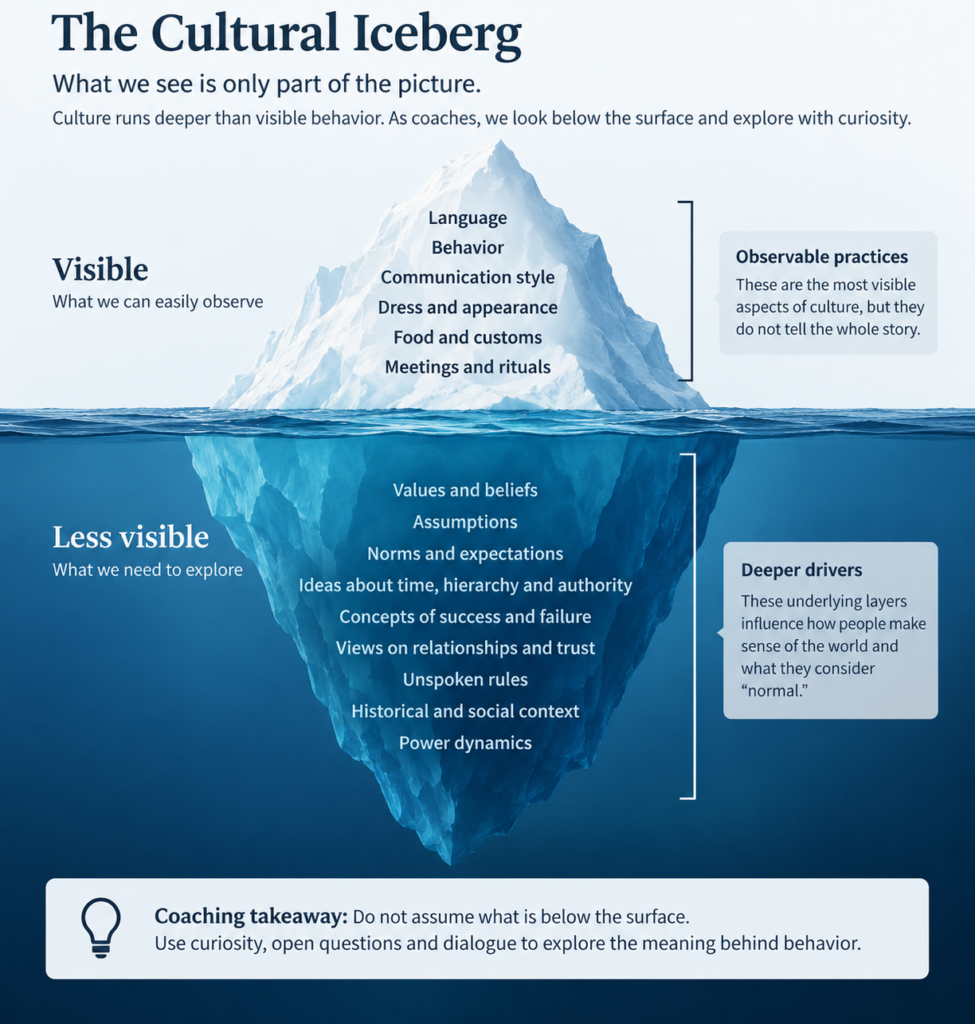
The iceberg reminds us that what we observe—language, behavior, greetings, communication or meeting practices—is only part of the picture.
Below the surface may be values, assumptions, history, expectations, beliefs, unspoken rules and power dynamics.
The coaching challenge is simple:
Do not infer what is below the surface without checking with the person.
The Cultural Onion
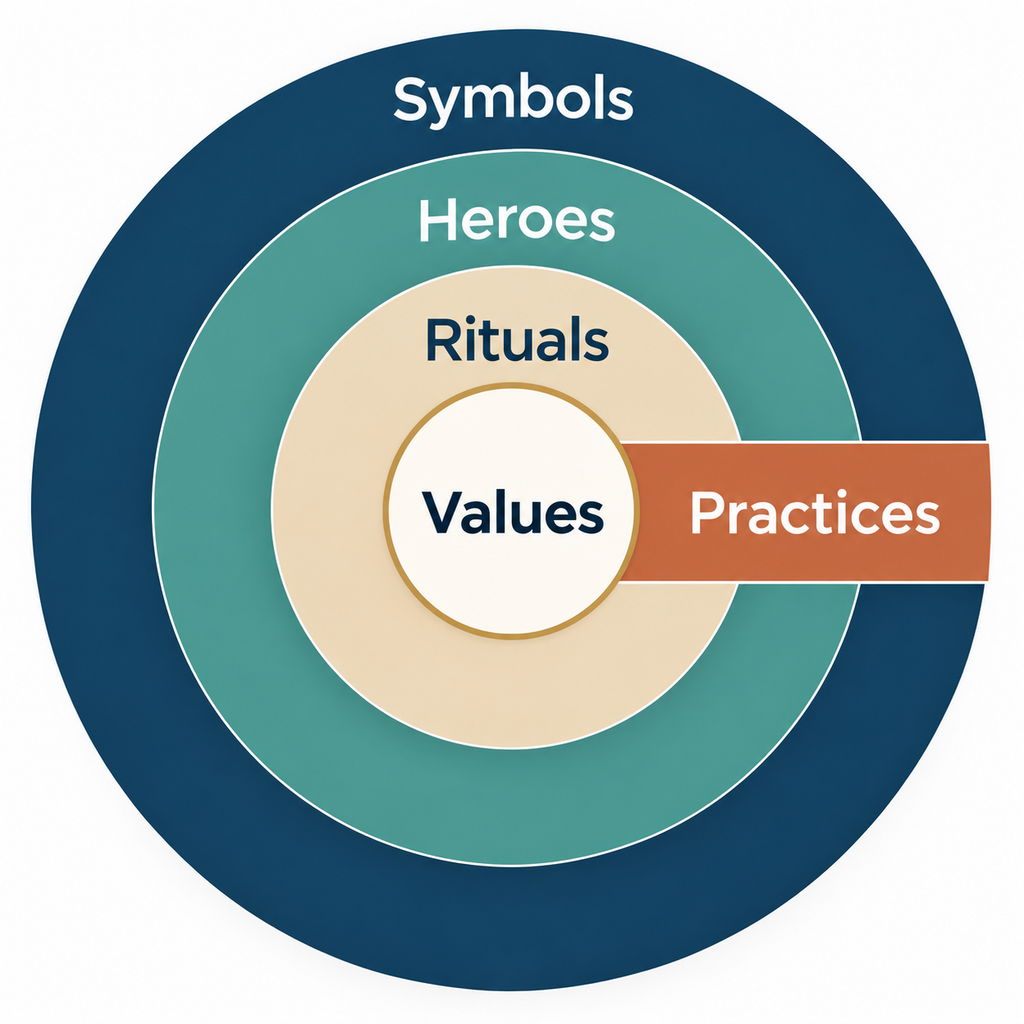
The cultural onion similarly distinguishes visible practices—such as symbols, heroes and rituals—from less visible values.
Models such as these can enrich cultural understanding. But people belong to many intersecting cultures, and even an accurate description of a group does not tell us what is true for a particular person.
4. “I Don’t Know Enough About This Culture”
One of the concerns coaches may bring to intercultural work is:
“What if I don’t know enough about the client’s culture?”
Our approach does not require the coach to become an expert on every culture.
Instead, we work with three layers:
1. Inquiry Discipline
Use the LENSES Method to generate better questions rather than conclusions about the client.
2. Knowledge Base
Use cultural research, models and other sources to prepare—but hold that knowledge as hypotheses to explore.
3. Process Tools
Use structured reflective tools that allow clients and teams to make sense of their own experiences.
The coach’s value is therefore not in having every cultural answer. It lies in the capacity to inquire, listen, adapt, notice power, exercise contextual judgment and respond ethically when difference matters.
5. Tools for Practice
The framework is supported by practical tools designed to create reflection and inquiry rather than to label people.
LENSES Sense-Making Tool
Six reflective prompts—one for each lens—to help individuals and teams explore a situation from multiple perspectives.
It generates material for coaching; it is not a cultural personality test or score.
Team Intercultural Climate Profile
A team-level tool designed to explore shared and differing experiences within a team.
Its focus is the team environment and experience, not the cultural competence or cultural traits of individual members.
Newcomer Experience Profile
A tool for people entering a new cultural context, designed to explore their experience of the inclusivity of that environment.
It does not assess whether the newcomer is culturally “competent.”
6. From Knowledge to Intercultural Coaching Competence
Throughout the program, participants move beyond learning about cultural difference to practicing how to coach within it.
The LENSES framework appears across reflection, behavioral indicators, case work, observed practice, individual coaching and team coaching. The intention is to connect intercultural theory with what the coach actually notices, asks, does and reflects on in practice.
This approach is also complementary to professional coaching standards. ICF’s Team Coaching Competencies, for example, emphasize awareness of team culture and coach bias, multiple perspectives, participation, team dynamics, conflict, systemic awareness and adaptation.
You do not need to know everything about every culture.
You need to know how to remain curious, culturally humble and professionally skillful when you don’t.
7. Intercultural Competence vs. Cultural Intelligence (CQ)
Cultural Intelligence (CQ) is a well-established, research-based capability for functioning effectively in culturally diverse situations. It is commonly understood through four capabilities: Drive, Knowledge, Strategy, and Action—developing the motivation, understanding, planning, and behavioral adaptability needed to work across difference.
Intercultural competence is a broader concept: the capacity to engage effectively and appropriately across cultural difference through awareness, knowledge, skills, reflection, and relationship.
In our program, CQ provides an important foundation, but we take the learning into the coaching relationship. The LENSES Method develops intercultural coaching competence—helping coaches apply cultural awareness through inquiry, relational attunement, adaptation, awareness of power and inclusion, and ethical reflection and repair.
Simply put: CQ helps us develop our capacity to work across cultures; LENSES helps us apply that capacity in the coaching moment.
Sources
Primary source: Intercultural Coaching Competence Framework — L1–L6 Terminology Reference Sheet, Sections 5–10.
For the cultural onion, the source document cites Hofstede, Hofstede & Minkov (2010), Cultures and Organizations.
For professional coaching context, see the official ICF Team Coaching Competencies, which ICF describes as building on the Core Competencies with team-specific sub-competencies.