
Seeing More Before Deciding What It Means
The LENSES Method is a research-informed developmental framework for intercultural coaching competence. It helps coaches work more thoughtfully with culture, identity, context, relationships and power—without turning cultural knowledge into assumptions about an individual.
At the heart of the framework is one principle:
Culture generates questions, not answers about the client.
A lens is something we look through. It changes what we notice and the questions we ask. The six LENSES therefore provide six complementary perspectives that coaches can draw on according to what is happening in the coaching relationship.
1. The Six Lenses at a Glance
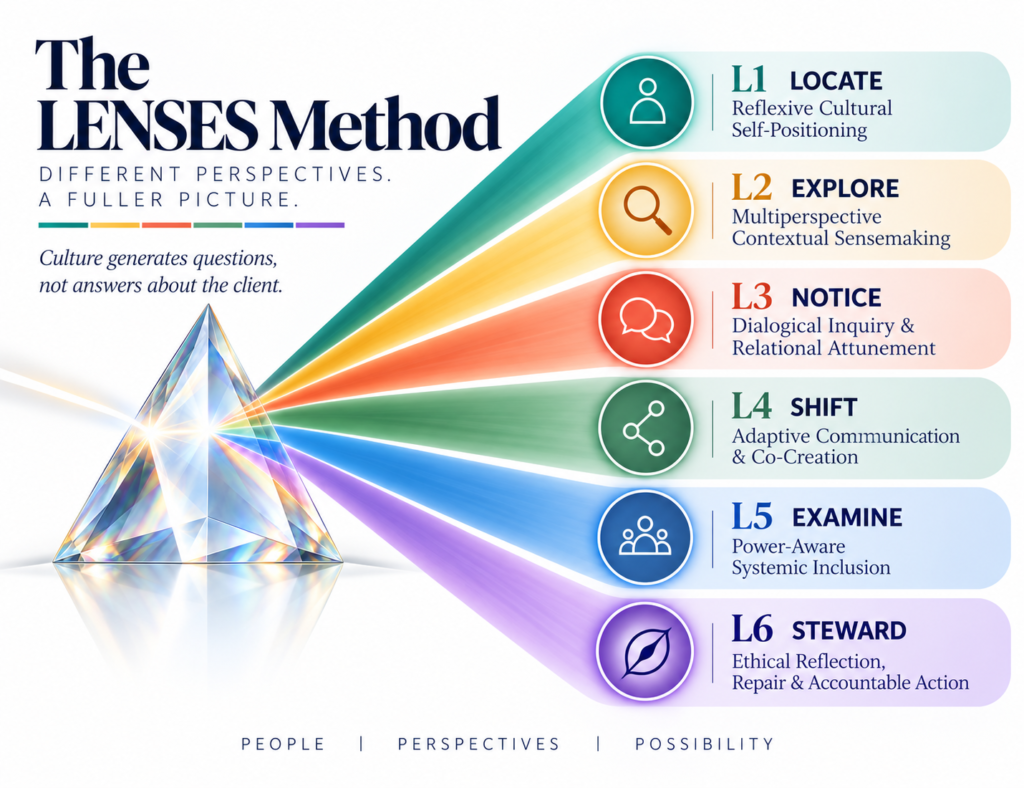
L1 — LOCATE
Reflexive Cultural Self-Positioning
Begin with yourself. Notice how your identities, cultural learning, position, biases, emotions and professional authority may influence what you see and how you interpret the client.
Key question:
What am I assuming — and whose framing am I treating as “the way”?
L2 — EXPLORE
Multiperspective Contextual Sensemaking
Resist the first explanation. Consider multiple cultural and non-cultural possibilities, remain open to uncertainty and look for information that could challenge your initial interpretation.
Key question:
What else could this be — and what would I need to find out before deciding?
L3 — NOTICE
Dialogical Inquiry & Relational Attunement
Listen for meaning rather than assigning it. Pay attention to language, context, emotion and what may remain unspoken, while allowing the client to define what their experience means.
Key question:
What does this mean to them — and have I checked, or am I decoding?
L4 — SHIFT
Adaptive Communication & Co-Creation
Adapt communication, pace, structure and challenge when it serves the relationship—while protecting authenticity, dignity and client agency.
Key question:
Where would adapting help — and where would it erase someone?
L5 — EXAMINE
Power-Aware Systemic Inclusion
Look beyond the individual to the wider system. Notice how identity, hierarchy, status, norms and structures may influence voice, belonging, risk and decision-making.
Key question:
Whose contributions get taken up — and who can disagree, at what cost?
L6 — STEWARD
Ethical Reflection, Repair & Accountable Action
Pay attention to impact. When misunderstanding, misattunement or harm occurs, take appropriate responsibility, engage in repair and turn the experience into learning and changed practice.
Key question:
If a rupture is forming, what would repair at the level of the dynamic look like?
2. From Lens to Coaching Practice
Intercultural coaching competence is not demonstrated by knowing everything about every culture. It is demonstrated in how the coach works with uncertainty and difference.
LENSES turns that principle into observable practice:
- Locate — Treat your interpretation as tentative and examine what you are bringing to it.
- Explore — Generate more than one possible explanation.
- Notice — Check meaning with the client rather than decoding behavior for them.
- Shift — Adapt intentionally and check whether the adaptation actually helps.
- Examine — Notice who has voice, influence, belonging and the ability to disagree.
- Steward — Attend to impact, take responsibility where appropriate, repair and learn.
This is an important distinction. For example, silence could reflect personality, a cultural norm, the quality of the relationship, a power dynamic or the structure of the environment itself. The coach’s task is not to decide which explanation is “the cultural one.” The task is to hold possibilities open and inquire.
3. LENSES and the ICF Core Competencies
LENSES is not a ninth ICF competency and does not replace the ICF Core Competencies. It is designed as an intercultural coaching overlay that brings additional attention to culture, context, identity, power, adaptation and ethical reflection.
At a high level, the framework connects the lenses with ICF practice in the following ways:
| Lens | Primary ICF Connections |
|---|---|
| L1 Locate | Embodies a Coaching Mindset |
| L2 Explore | Listens Actively; Evokes Awareness |
| L3 Notice | Cultivates Trust and Safety; Listens Actively |
| L4 Shift | Establishes and Maintains Agreements; Evokes Awareness; Facilitates Client Growth |
| L5 Examine | Demonstrates Ethical Practice; systemic and power awareness |
| L6 Steward | Demonstrates Ethical Practice; Embodies a Coaching Mindset; Facilitates Client Growth |
In team coaching, these perspectives widen from the coach-client relationship to the team as a system. Attention may include multiple perspectives, participation, power, alliances, conflict, stakeholder relationships, collective learning and repair.
The current ICF Core Competencies framework was introduced in 2025 and organizes professional coaching around four domains: Foundation, Co-Creating the Relationship, Communicating Effectively, and Cultivating Learning and Growth. (ICF)
Explore the 2025 ICF Core Competencies
Explore the ICF Team Coaching Competencies
4. When Culture Moves From Background to Foreground
The same six lenses apply whether culture is simply part of the context or is explicitly at the center of the coaching conversation. What changes is the weighting.
When culture is incidental
Culture may be present without being the stated issue. Here, L2 Explore and L3 Notice become especially important. They help the coach hold multiple explanations, check meaning and avoid stereotyping.
When culture is the explicit topic
When identity, belonging, cultural difference or power becomes central, L5 Examine moves toward the center, while L1 Locate becomes more prominent. L6 Steward may also carry greater weight because ruptures involving identity or power can have greater consequences and require more intentional repair.
The principle remains unchanged:
Use culture to generate better questions—not to predict the person.
Framework Status
The LENSES Method is a research-informed developmental framework and a coaching-specific integration of intercultural and coaching theory. It maps conceptually to the ICF Core Competencies.
It is not presented as an ICF-endorsed framework, diagnostic instrument or validated psychometric assessment. Candidate instruments associated with the framework require further validation.
Sources
Bennett, M. J. (1986). A developmental approach to training for intercultural sensitivity.
Bennett, M. J. (2017). Developmental model of intercultural sensitivity.
Bird, A., Mendenhall, M., Stevens, M. J., & Oddou, G. (2010). Defining the content domain of intercultural competence for global leaders.
Bowleg, L. (2012). The problem with the phrase women and minorities: Intersectionality—an important theoretical framework for public health.
Byram, M. (1997). Teaching and assessing intercultural communicative competence.
Byram, M. (2021). Teaching and assessing intercultural communicative competence: Revisited.
Byram, M., & Zarate, G. (1996). Defining and assessing intercultural competence: Some principles and proposals for the European context.
Chua, R. Y. J., Morris, M. W., & Mor, S. (2012). Collaborating across cultures: Cultural metacognition and affect-based trust in creative collaboration.
Cole, E. R. (2009). Intersectionality and research in psychology.
Fletcher, G. J. O., Danilovics, P., Fernandez, G., Peterson, D., & Reeder, G. D. (1986). Attributional complexity: An individual differences measure.
Foronda, C., Baptiste, D.-L., Reinholdt, M. M., & Ousman, K. (2016). Cultural humility: A concept analysis.
Hook, J. N., Davis, D. E., Owen, J., Worthington, E. L., Jr., & Utsey, S. O. (2013). Cultural humility: Measuring openness to culturally diverse clients.
Leung, K., Ang, S., & Tan, M. L. (2014). Intercultural competence.
Longmire, N. H., & Harrison, D. A. (2018). Seeing their side versus feeling their pain: Differential consequences of perspective-taking and empathy at work.
Nugent, K., & Catalano, T. (2015). Critical cultural awareness in the foreign language classroom.
Roccas, S., & Brewer, M. B. (2002). Social identity complexity.
Soliz, J., & Giles, H. (2014). Relational and identity processes in communication: A contextual and meta-analytical review of communication accommodation theory.
Sorrells, K., & Sekimoto, S. (2025). Intercultural communication: Globalization and social justice (4th ed.).
Spitzberg, B. H., & Changnon, G. (2009). Conceptualizing intercultural competence.
Tervalon, M., & Murray-García, J. (1998). Cultural humility versus cultural competence: A critical distinction in defining physician training outcomes in multicultural education.
Todd, A. R., & Galinsky, A. D. (2014). Perspective-taking as a strategy for improving intergroup relations: Evidence, mechanisms, and qualifications.