
Intercultural Competence in Coaching & Team Coaching
ICF Continuing Coach Education Program
Develop the intercultural awareness, Cultural Intelligence (CQ), and coaching capability to work more effectively across cultures, identities, and differences.
30 hours · ICF CCE · Online · Starts October 24, 2026 · Biweekly at 10:00 AM ET

About the Program
Designed for practicing coaches who want to strengthen their intercultural coaching competence, this program explores how culture and identity can influence the coaching relationship, communication, trust, expectations, and meaning-making.
Rather than teaching formulas about different cultures, we develop the coach’s capacity for cultural self-awareness, curiosity, cultural humility, and adaptability.
The program combines intercultural competence and Cultural Intelligence (CQ) with professional coaching practice, creating space to examine both the client’s cultural context and the cultural lenses we bring to our work as coaches.
Key Learning Areas
Cultural Identity & Coaching Across Difference
Explore how cultural identity, lived experience, values, and assumptions can influence both coach and client—and how greater self-awareness can strengthen coaching presence.
Cultural Intelligence & Adaptability
Develop Cultural Intelligence (CQ) as a practical coaching capability. Learn to recognize cultural patterns while avoiding stereotypes and remaining curious about the individual in front of you.
Communication, Trust & Psychological Safety
Explore how culture can influence communication, trust, participation, disagreement, and expectations within coaching relationships and teams.
Inclusion, Gender & Generational Perspectives
Consider how gender, generation, national culture, and lived experience intersect—and how coaches can create space for different perspectives without reducing people to cultural categories.
Teams Through an Intercultural Lens
Develop greater awareness of how culture can shape team relationships, roles, authority, collaboration, and the ways people understand leadership and belonging.
Ethics, Boundaries & Coaching Relationships
Strengthen your ability to navigate coaching agreements, professional boundaries, stakeholders, and ethical considerations across different cultural and organizational contexts.
Three Layers of Culture
The program explores three intersecting dimensions of cultural identity:
National Culture · Gender · Generational Culture
These dimensions are not treated as separate boxes. We explore how they interact with individual identity, lived experience, organizational context, relationships, and power.
The goal is not to predict someone’s behavior based on a cultural category. It is to help coaches notice more, assume less, inquire more deeply, and adapt more intentionally.
Our Approach
Culture isn’t a module. It’s a lens.
Intercultural competence isn’t something we teach once and then leave behind.
It is woven throughout how we explore coaching presence, identity, communication, trust, ethics, relationships, teams, power, conflict, leadership, and systemic dynamics.
We don’t aim to create coaches who believe they “know” other cultures.
We develop coaches who are better prepared to encounter difference with curiosity and humility, recognize their own cultural lenses, and adapt intentionally while maintaining professional coaching integrity.
Who This Program Is For
This intercultural coaching program is designed for practicing coaches who want to strengthen their ability to work effectively across cultures, identities, and differences.
It is particularly relevant for coaches who:
- work with clients across national, cultural, or intercultural contexts;
- coach leaders working in global, international, or culturally diverse organizations;
- work with multicultural, intercultural, or multigenerational teams;
- want to better understand how culture and identity influence coaching relationships, communication, and trust; or
- want to develop their Cultural Intelligence (CQ), intercultural competence, and intercultural coaching capability.
An existing ICF credential is not required to participate.
Program Details
| Program | Intercultural Competence in Coaching & Team Coaching |
| Accreditation | ICF Continuing Coach Education (CCE) |
| CCE Hours | 30 CCE hours: 24 Core Competency + 6 Resource Development |
| Delivery | Online, combining synchronous and asynchronous learning |
| Language | English |
| Next cohort | Starts October 24, 2026 |
Meet the Faculty
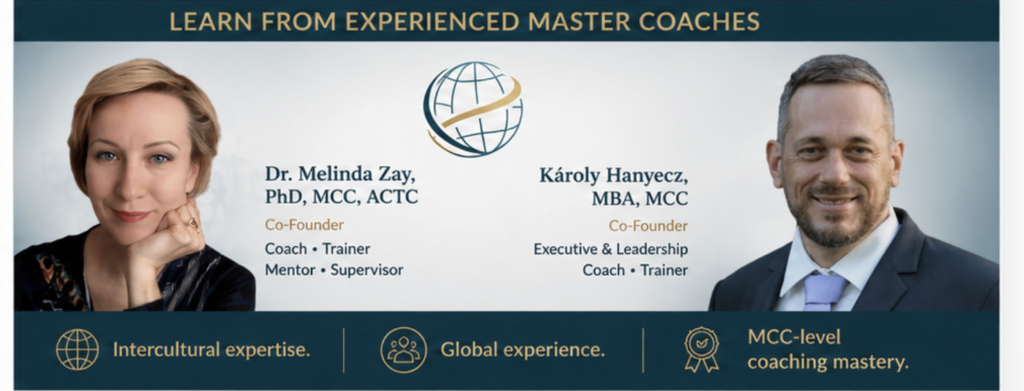
The program is led by the founders of the Intercultural Coaching Academy, bringing together MCC-level coaching experience, intercultural expertise, and extensive experience working across cultures and organizational contexts.
Dr Melinda Zay, PhD, MCC, ACTC
Executive Coach · Team Coach · Interculturalist · Psychological Safety Consultant · Coach Mentor & Supervisor
Melinda combines advanced coaching practice with academic expertise in intercultural communication. Her work spans executive and leadership development coaching across five continents, with a particular focus on intercultural competence, team dynamics, and psychological safety.
Karoly Hanyecz, MBA, MCC
Leadership & Executive Coach · Team Coach · Agile Coach · Interculturalist & Relocation Coach
Karoly brings extensive leadership, executive, team, and intercultural coaching experience, with practical experience working across cultures and organizational environments.
Program Investment
Regular Tuition: $2,500 USD
Payment Plan: 2 monthly payments of $1,300 USD
Early Bird Tuition: $2,250 USD
Early Bird Payment Plan: 2 monthly payments of $1,200 USD
Available through October 10
The program investment includes the complete 30-hour intercultural coaching program, including synchronous and asynchronous learning and all program materials.
Register for the October CohortContinuing to Advanced Intercultural Team Coaching
The 30-hour program is a complete professional development program in intercultural coaching and intercultural competence in its own right. It also forms the foundation of our 65-Hour Advanced Intercultural Team Coaching program, accredited by ICF as an Advanced Accreditation in Team Coaching (AATC).
Both programs begin together in October. Participants registered for the 65-hour program complete the 30-hour intercultural foundation before continuing into the advanced stage, with a further 35 hours focused on systemic team coaching, applied practice, feedback, reflection, and coaching supervision.
Participants who initially register for the 30-hour program may also choose to continue into the advanced stage, subject to availability.
Explore the 65-Hour Advanced Program